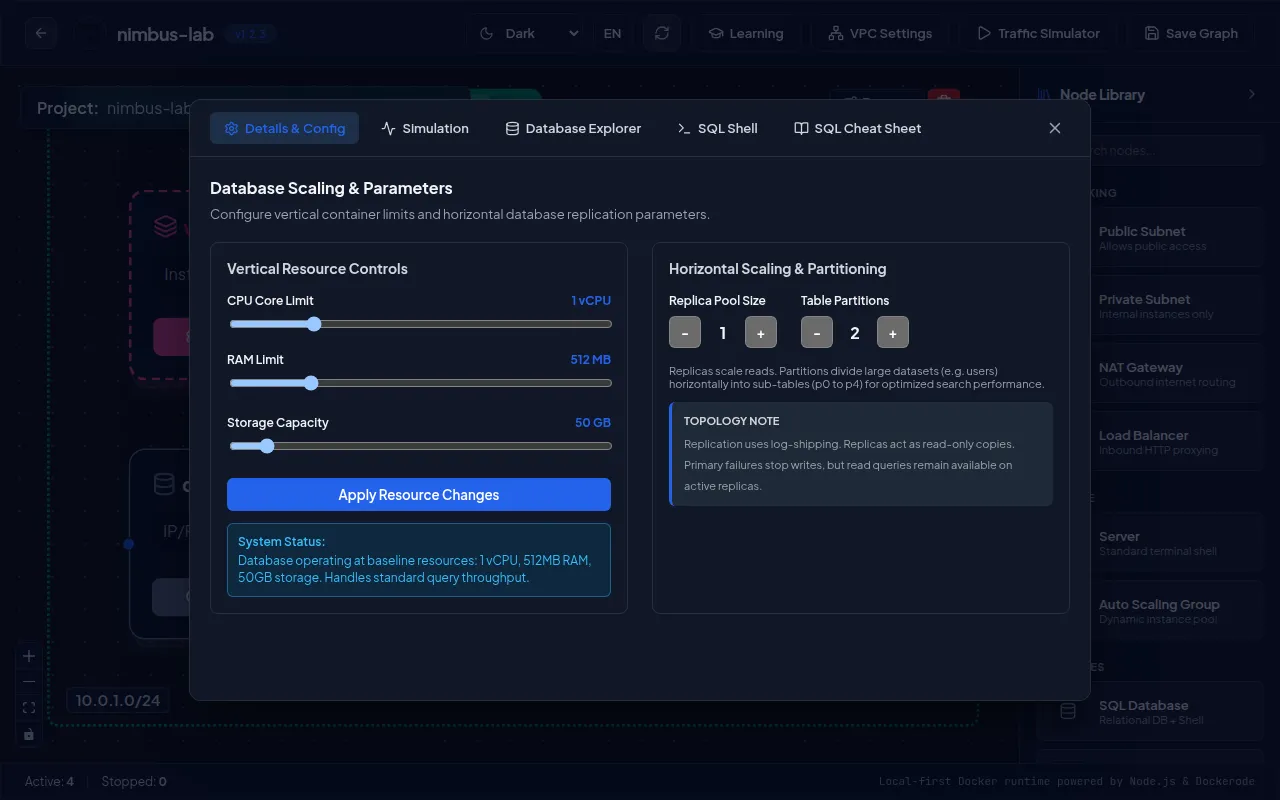
Student inspection
Inspect the system behind the diagram
Students can open the database explorer, change resource limits and use the SQL shell against the PostgreSQL container running on their machine.
For instructors, bootcamps, and teaching labs
Students build containers, networks, and service dependencies on their own machines. Each exercise is checked against the live Docker state, so a pass records a working system rather than a submitted diagram.
MIT licensed · no student accounts · Docker required on each machine
The same local engine runs Torollo’s built-in roadmaps and instructor-authored labs. Students use the visual canvas, terminals, and service explorers to do the work.
Student inspection
Students can open the database explorer, change resource limits and use the SQL shell against the PostgreSQL container running on their machine.
Classroom requirements
Every student needs Docker on Linux, macOS, or Windows with WSL 2. Torollo runs the architecture locally, so the institution does not need a cloud account for each student.
install: npx torollo start
Start immediately
The catalogue covers a resilient three-tier system, Redis cache-aside, and workers with a Redis job queue. Each roadmap is a sequence of verifiable steps.
Review the roadmap catalogueAdapt it to your syllabus
Define a topology, initial state, steps, hints, and declarative validators. Course files can be reviewed and versioned like the rest of your teaching material.
Read the public format specificationThe product can support a demonstration, a guided practice session, or a custom assignment. The runtime and validation model stay the same.
Teaching mode
Build an architecture on the canvas, open a shell into a node, change the network, and run a validator while students can see the expected and observed state.
Teaching mode
Assign one of the three free roadmaps. Every student runs an independent copy and can retry checks without waiting for a shared environment.
Teaching mode
Write a roadmap against your syllabus. The assignment ends when the declared validators pass on the student’s local containers.
Instructor workflow
The assignment describes observable system state. Torollo supplies the local runtime and the validator that checks it.
Choose what should exist when the exercise is complete: running containers, a reachable service, a database record, a blocked network path, or another state Torollo can inspect.
course work: learning objective
A roadmap declares the starting topology, instructions, hints, and validators in JSON. The format is documented and lives with the open-source engine.
course work: roadmap file
Each student starts Torollo on a Docker-capable laptop or lab machine. They change real containers, networks, and service configuration inside their own local environment.
student work: live architecture
A failed check reports the expected and observed state. The student keeps working until the local system passes. Torollo provides the validation result; it does not ship a classroom gradebook.
student result: local validation
Students assemble the architecture, change the live system, and pass by producing the state the assignment asked for.
Available today
Students can practice resilient three-tier architecture, cache-aside with Redis, and workers with a Redis job queue.
The canvas, Docker runtime, terminals, network engine, validators, and every current node type are MIT licensed.
Course-specific roadmaps are JSON files. Instructors can review and version them without modifying the engine.
Validators explain what they inspected. Students get a concrete failure to diagnose and a concrete pass when the state is correct.
Current boundary
Free, local, instructor-led
Torollo does not currently provide hosted student machines, classes, SSO, or a teacher dashboard. The engine and authoring format are available now. If you use them in a course, your feedback can show which education support is worth building.
Tell us about your courseStart the free engine, complete one lab, and inspect the roadmap format. If it fits your teaching, tell us what you plan to assign and what is missing.